
HeliosX field notes
Galilean vs Prismatic Loupes
Short answer: Choose Galilean loupes for 2.5x–3.5x: they are lighter, simpler, cheaper and give a wider, deeper view. Choose prismatic loupes for 4.0x and above, where they give a sharper, flatter image at the cost of weight. Choose ergonomic prismatic loupes if neck posture is the main problem. HeliosX Galilean pairs start at $695 and prismatic at $1,195.
There are only two optical designs in surgical and dental loupes, and almost every purchasing decision comes down to which one you need. Galilean systems use a simple two-lens arrangement. Prismatic systems fold the light path through prisms, which is what lets them reach higher magnification without becoming absurdly long. Neither is better in the abstract. They fail in different places, and the right question is which set of compromises matches your work.
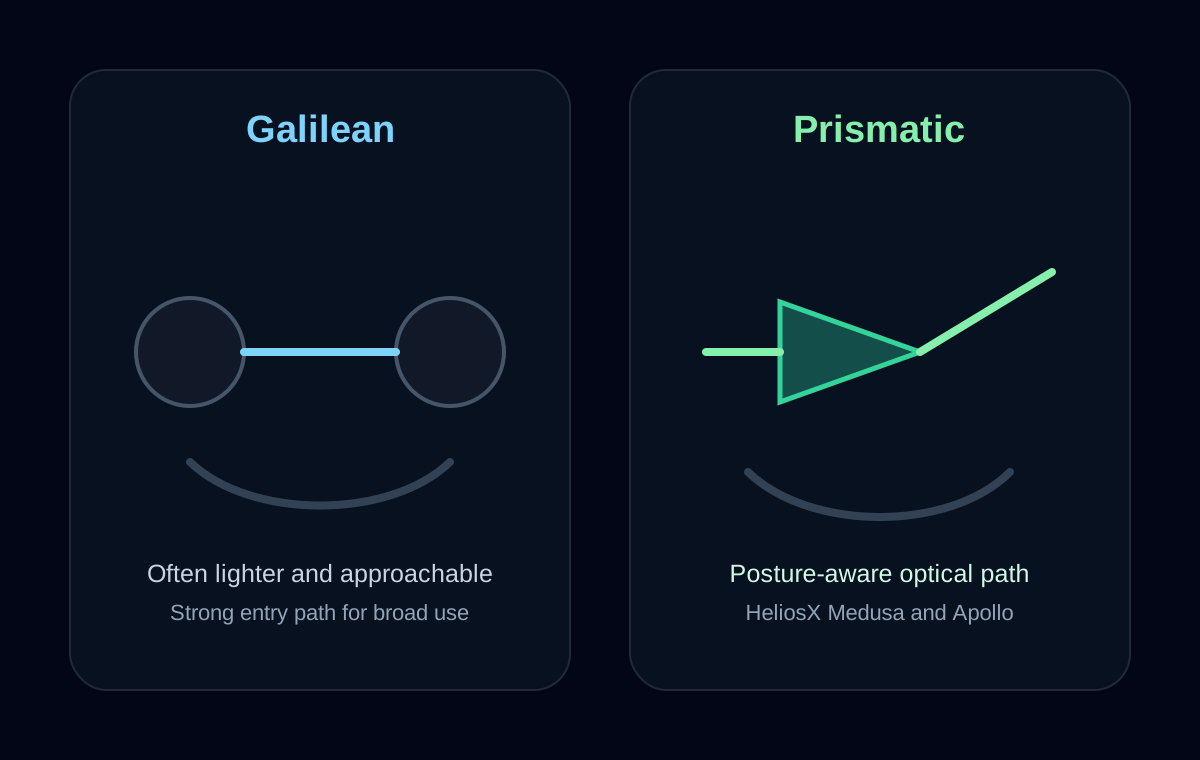
How a Galilean loupe works
A Galilean telescope is two lenses — a converging objective and a diverging eyepiece — with nothing folding the path between them. That simplicity is the whole advantage: fewer elements means less glass, less weight, and less cost. The limitation is equally structural. Beyond roughly 3.5× the design starts giving up too much in field of view and edge sharpness to be worth it, which is why virtually no manufacturer sells a Galilean loupe above that figure. HeliosX Galileo and Newton are both Galilean, and both stop at 3.5× for that reason.
- Two lenses, no folded path — the simplest design available.
- Lighter and less expensive than an equivalent prismatic.
- Practical ceiling around 3.5×, which is a physical limit rather than a product decision.
How a prismatic loupe works
A prismatic loupe — sometimes called Keplerian — uses prisms to fold the light path back on itself inside the barrel. That folding is what makes higher magnification physically practical: without it, a 5× loupe would need a barrel long enough to be unwearable. The payoff is real resolution and a usable field at magnifications a Galilean cannot reach. The cost is weight, length, and price, because you are adding precision glass and the assembly tolerances get tighter. HeliosX Kepler, Apollo and Medusa are all prismatic.
- Prisms fold the optical path so higher magnification fits in a wearable barrel.
- Better resolution and field at 4× and above.
- Heavier and more expensive — you are paying for more glass, made more precisely.
The ergonomic prismatic distinction
This is the part that gets flattened in most comparisons, and it matters more than the Galilean-versus-prismatic question itself. Not every prismatic loupe is ergonomic. A conventional prismatic gives you the magnification but keeps traditional geometry — you still tilt your head down to look through it. An ergonomic prismatic uses the prisms to redirect the line of sight downward, so your head stays neutral and your eyes look straight ahead while the optics carry the view down to the field. HeliosX Kepler is a conventional prismatic built for high magnification; Apollo and Medusa are ergonomic prismatics built around that redirection.
- Prismatic describes the optics; ergonomic describes the geometry.
- A prismatic loupe is not automatically an ergonomic one.
- The ergonomic version is what changes cervical load over a career.
Which one your work actually needs
If you spend your day at 2.5× to 3.5× and weight matters more than magnification ceiling — general dentistry, hygiene, most everyday surgical work, and nearly all training — Galilean is the correct answer, not the budget compromise. If your work genuinely requires 4× or more, the question answers itself, because Galilean does not go there. The interesting decision sits in the middle: if you need higher magnification and you also expect to be doing this for another twenty years, the ergonomic prismatic premium buys posture rather than optics.
- Everyday work at 2.5–3.5×: Galilean, and no apology needed.
- Microsurgery, anastomosis, endodontics at 4×+: prismatic is the only option.
- High magnification plus a long career ahead: ergonomic prismatic.
What the naming means at HeliosX
The product names are not decorative. Galileo and Newton are Galilean designs, capped at 3.5× where that optical arrangement stops being sensible. Kepler is named for the Keplerian design that prismatic loupes are built on, and covers 4.0× to 6.0× for microsurgical work. Apollo and Medusa are ergonomic prismatics, with Medusa adding a working distance adjustable from 300 mm to 600 mm for clinicians who move between seated and standing work. The lineup is the optics, labelled honestly.
- Galileo, Newton — Galilean, 2.5–3.5×.
- Kepler — prismatic, 4.0–6.0×, conventional geometry.
- Apollo, Medusa — ergonomic prismatic; Medusa adjusts 300–600 mm.
Common questions
Are prismatic loupes better than Galilean loupes?
Not in the abstract. Prismatic optics are necessary above about 3.5× and, in ergonomic form, better for posture. Galilean loupes are lighter and less expensive, and at 2.5–3.5× they are the right tool rather than a compromise. Match the design to the work, not to the price.
Why do Galilean loupes stop at 3.5×?
It is a limitation of the design rather than a product decision. Without prisms folding the light path, pushing a two-lens system past roughly 3.5× costs too much field of view and edge sharpness to be worth selling.
Is every prismatic loupe ergonomic?
No, and this is the most common misunderstanding in the category. Prismatic describes the optics; ergonomic describes whether the geometry redirects your line of sight downward so your head can stay neutral. Kepler is prismatic but conventional. Apollo and Medusa are ergonomic prismatics.
Are prismatic loupes heavier?
Yes. More glass, folded paths and tighter assembly tolerances all add mass. That is the trade for magnification you cannot otherwise reach, and it is why weight matters most to people who wear loupes all day at lower magnification.
Which design should a student buy first?
Galilean, in almost every case. It covers the magnification range training actually requires, weighs less over a long day, and costs meaningfully less at a point when most people are not yet certain what their long-term work will look like.
Need help applying this to your setup?
Tell us your specialty, usual working position, and the question you are trying to resolve. Ask before ordering if your configuration is uncertain.