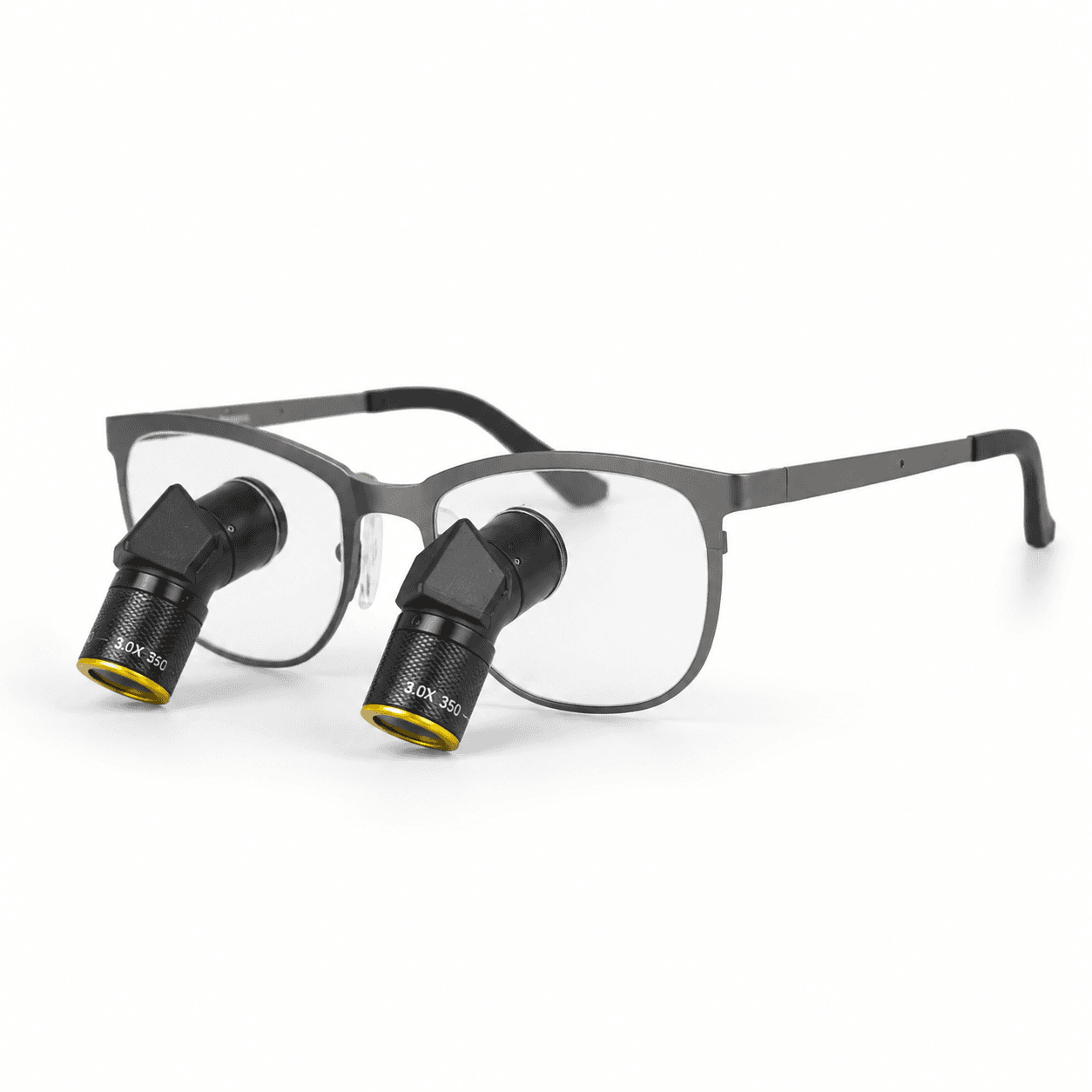
Apollo
From $1,695Ergonomic prismatic loupes for clinicians who want posture-aware clarity and high-magnification options.
Working distance is fixed to your configuration; magnification is selected at purchase.
Explore ApolloHand surgery
Hand surgery sits at the higher end of loupe magnification by necessity. The structures involved — digital nerves measured in millimeters, flexor tendons with surfaces requiring epitendinous repair, vascular pedicles for free flaps and replantation — operate at the limit of useful loupe optics. Most hand surgeons own one loupe configured for routine hand work and either own a second for microvascular cases or use the operating microscope when magnification needs exceed 6.0x.
We make and sell HeliosX loupes. This is our buying guidance, not an independent product test or paid ranking.
.png&w=3840&q=75)
Apollo · From $1,695 USD
Your HeliosX shortlist
Compare the optical design, then choose your magnification and frame on the product page.
Ergonomic prismatic loupes for clinicians who want posture-aware clarity and high-magnification options.
Working distance is fixed to your configuration; magnification is selected at purchase.
Explore ApolloConventional prismatic loupes for higher-magnification work, available in 4.0x, 5.0x, and 6.0x.
Conventional prismatic optics. Choose Apollo or Medusa for ergonomic viewing.
Explore KeplerErgonomic prismatic loupes with adjustable working distance for clinicians who change posture between seated and standing work.
Working distance adjusts from 300–600 mm. Magnification does not switch on the loupe.
Explore MedusaStarting prices in USD. Magnification and optional prescription lenses affect the total; shipping and taxes appear at checkout. See all five models.
The hand is small. Every structure of clinical interest — flexor tendons, digital nerves, neurovascular pedicles, articular surfaces — is measured in millimeters. The suture sizes match: 4-0 for tendon core, 6-0 to 7-0 for epitendinous repair, 8-0 to 10-0 for microvascular work. Loupe magnification for hand surgery is not about extracting marginal precision — it is about being able to see the work at all.
Hand surgeons generally choose from three configurations depending on how much microvascular work is in the case mix.
Hand work happens closer to the surgeon than most other surgical specialties. The operator sits with hands and forearms in the surgical field, the patient’s hand on a hand table within easy reach. Standard surgical working distances of 16 to 18 inches are too long for many hand surgeons; 13 to 15 inches is common. A loupe sized for a standard surgical working distance forces the surgeon to lean forward or accept off-axis viewing. The fit step matters more in hand surgery than in most specialties.
Above 6.0x magnification, the operating microscope tends to outperform the loupe in three ways: stable position without head movement, integrated coaxial lighting, and shared viewing for assistant and resident. Most hand surgeons who do regular microvascular work end up owning both — loupes for routine hand cases and the microscope for microvascular and very fine work. The loupe-to-microscope crossover is around 6.0x.
Three models map onto hand practice depending on case mix.
HeliosX is built around a simple mission: make premium magnification more accessible. Compare our published prices and model specifications, then confirm the fit and support terms before committing to a custom pair.
Most hand surgeons work at 4.0x–5.0x for routine hand cases (tendon repair, nerve repair, small-bone fixation). Microvascular work pushes to 5.0x–6.0x, and above that range the operating microscope is more common.
For wrist and joint work in hand surgery, sometimes. For flexor tendon repair and nerve work, 4.0x or higher is the practical floor. Most hand fellows and specialists move to 4.5x within their first year.
For regular microvascular work, yes. For routine hand surgery without microvascular components, no — high-magnification loupes at 5.0x–6.0x cover the practice. Most hand surgeons with microvascular practice own both.
Hand work happens closer to the surgeon than standard surgical fields. A loupe sized to a 17-inch surgical working distance is uncomfortable for a hand surgeon working at 14 inches. The fit step is more consequential in hand surgery than in many other specialties.
Apollo at $1,695 covers routine hand work with ergonomic posture support. Kepler at $1,195 is the more affordable specialist pick. Fellow access pricing applies on both. Email heliosxloupes@gmail.com to confirm eligibility.
Yes if the range is wide enough. Medusa at 3.0x–8.5x adjustable working distance handles both, though most mixed-practice surgeons compromise by sizing the loupe to the dominant subspecialty.
Premium magnification. More accessible.
Tell us your specialty, typical procedures, current magnification, and budget. We can help you narrow the options before you order.
Email opens in your mail app: heliosxloupes@gmail.com · Two-year limited warranty
.png&w=3840&q=75)