Surgeon wearing HeliosX loupes in a clinical setting

Decision guide

Are Surgical Loupes Worth It? built around real clinical work.

Surgical loupes are worth the money for most clinicians who work on small structures, repetitive fine motor tasks, or in postures that punish the neck and back over years. They are not worth the money for everyone in every specialty — but the case for owning a pair is stronger than most undecided buyers realize, and the price-of-entry has dropped enough that the old "wait until you’re an attending" advice no longer holds.

01

Who loupes are worth it for

The case is strongest for clinicians whose case mix involves small structures, repetitive precision, or postures that compress the cervical spine across a workday. That covers more roles than the legacy "only attending surgeons" framing ever admitted.

Surgical residents and fellows — first pair pays off across thousands of cases over training; ergonomic gains compound over years.
Dental students, dental residents, and hygienists — fine motor work in a fixed seated posture is exactly what loupes are designed to support.
Plastic, hand, ENT, oral and maxillofacial, ophthalmic, microsurgery clinicians — case mix routinely demands magnification.
Cardiac, pediatric, and reconstructive surgeons working at small scale frequently.
Attendings replacing aging loupes — newer optical coatings and ergonomic prismatic designs are a real upgrade over a 10-year-old Galilean pair.

02

Who can wait or skip

Not every clinician needs loupes immediately, and a few will not benefit much at any career stage. Honest version: if your work is broad-field, low-precision, and you have not noticed strain from posture, the case is weaker.

Pre-clinical medical students — no procedural exposure yet; loupes can wait until clinical rotations clarify case mix.
Specialties dominated by microscope use (most of neurosurgery, parts of ophthalmology) — the microscope already does this job.
Clinicians without a defined case mix yet — buying high-magnification loupes before you know what you operate on most often is a common mistake.

03

What loupes actually deliver

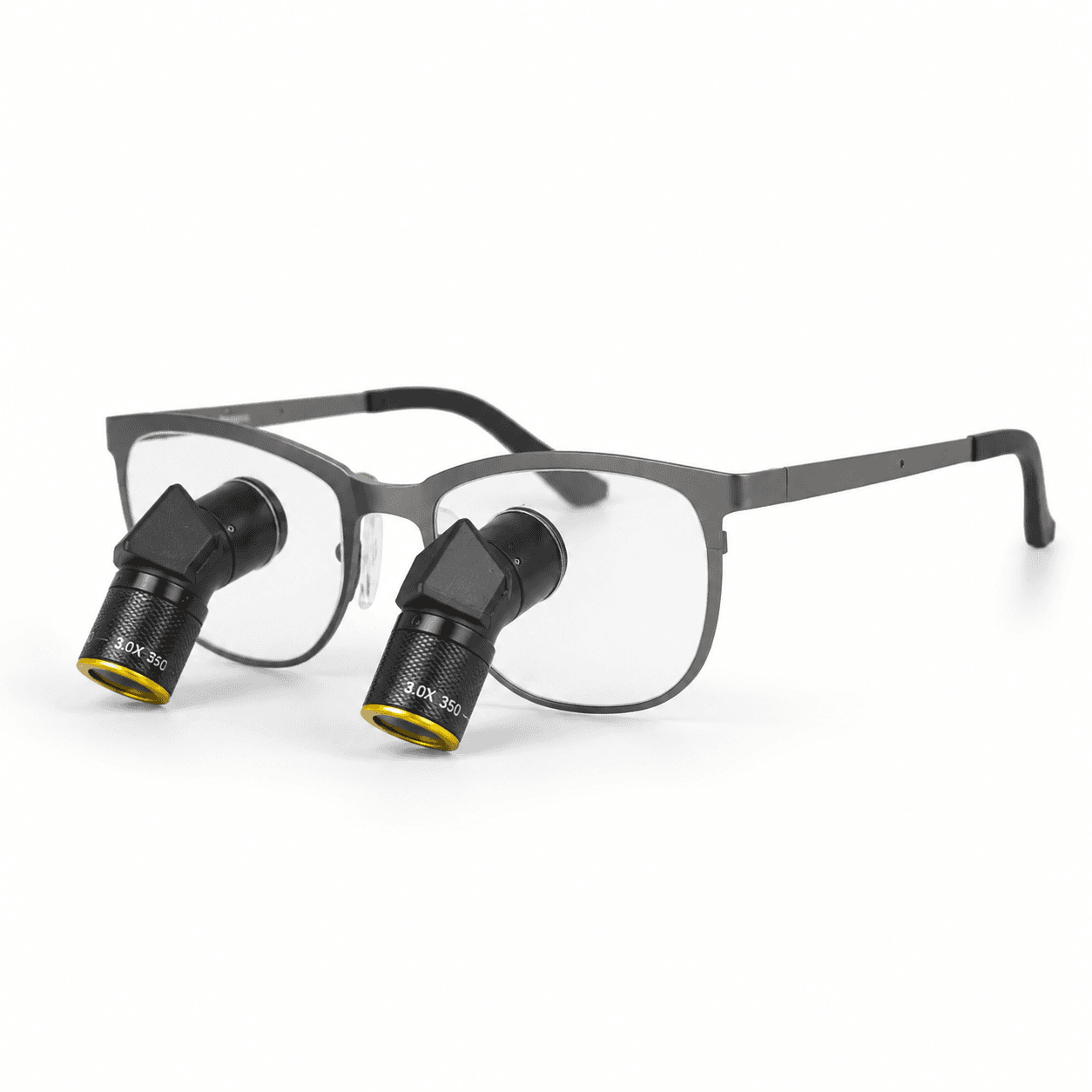
Two outcomes, both measurable. The first is visual: small structures appear at 2.5x to 6.0x larger with stable depth of field, which lets you operate on detail you would otherwise approximate. The second is ergonomic: a properly fit pair pulls the head into a more neutral posture by raising the working field instead of forcing the neck to drop toward it. The ergonomic gain is the one most underestimated by first-time buyers and most cited by experienced ones.

Visualization: magnification ranges from 2.5x (broad clinical) to 6.0x and beyond (microsurgery-adjacent).
Posture: ergonomic prismatic designs raise the field-of-view angle so the cervical spine stays closer to neutral.
Stamina: less compensatory squinting and posture-holding across long cases.
Consistency: fine motor work at the limit of unaided vision becomes routine once magnification is factored in.

04

What loupes do not fix

Loupes are not a posture cure-all. They reduce one specific kind of strain (sustained cervical flexion when the field is too low) but they do not solve back pain caused by chair height, monitor placement, microscope ergonomics, or fatigue. They also do not improve hand stability, magnification habits, or technique on their own.

Loupes do not fix back pain that comes from chair, monitor, or microscope ergonomics.
Loupes do not improve hand stability if the underlying issue is fatigue or technique.
Higher magnification does not equal better outcomes — it narrows field, shortens depth, and demands more from posture.

05

The real cost of waiting

The old advice was "wait until you’re an attending and someone else pays for them." That argument worked when a first pair cost $3,000 and resident salaries were what they were. It does not work as well now. A credible first pair from a direct-to-clinician brand starts under $1,000, custom IPD included; ergonomic prismatic systems with adjustable working distance sit around $1,695. Spread across five to ten years of clinical use, the cost per workday is meaningless. The accumulated postural load from a decade of operating without ergonomic support is not.

Cost-per-workday math on a $695 first pair across five years of clinical work: under 50 cents.
Ergonomic load accumulates faster than salary growth. Postponing the buy postpones the benefit, not the cost.
Used or borrowed loupes rarely fit correctly because pupillary distance and working distance are individual measurements.

06

Affordable without feeling cheap

A lower price should not force clinicians into vague specs, weak fit support, or disposable optics. HeliosX is built around affordable premium value: clear model roles, fair pricing, and guidance before production begins. A 2004 peer-reviewed survey of 148 specialists and senior trainees (Jarrett PM, Microsurgery 2004;24:420–422) documented the intraoperative magnification ranges that real surgeons actually use — useful context when comparing brand claims against case-mix reality.

Source: Jarrett PM. Intraoperative magnification: who uses it? Microsurgery. 2004;24:420–422.

Transparent product roles and price ranges.
Measurement guidance for pupillary distance and working distance.
Education-first buying support for students, residents, dentists, and surgeons.

Buyer criteria

Choose by work, posture, and fit.

A useful loupe guide answers the real buying question. Start with the procedures you perform, then compare optics around posture, magnification, fit support, and price.

Workflow

Which procedures, appointments, or cases will these loupes support most often?

Posture

Do you need ergonomic prismatic viewing or adjustable working distance?

Magnification

How much detail do you need before field of view becomes too narrow?

Fit

Do you have accurate pupillary distance, working distance, and prescription details?

Budget

Are you buying for school, residency, practice, or a focused upgrade?

Support

Can you easily get help with measurements, shipping, prescription, and setup?

Side-by-side

Comparison snapshot

Side-by-side comparison of HeliosX and Common alternative framing across 6 positioning factors.
FeatureHeliosXCommon alternative framing
When loupes are clearly worth itSurgical / dental residents, students, hygienists, plastics, hand, ENT, oral max, ophthalmic, microsurgery, cardiac, pediatricEven broad general practice benefits if posture is an issue
When loupes can waitPre-clinical med students, undefined case mixSame
Entry cost for a credible first pair$695 (Newton) — custom IPD includedHistorically $2,500–$4,000 from legacy brands
Ergonomic prismatic entry$1,695 (Apollo, Medusa)$3,500–$5,500+
Primary measurable outcomesMagnification 2.5x–8.5x; ergonomic posture supportSame physical outcomes; price determines access
Cost-per-workday over 5 years (entry pair)Under $0.50/day on a $695 pairRoughly $1.50–$2.50/day on a $3,000 legacy pair

For most surgical, dental, and procedural clinicians, loupes are worth the money — and the case has gotten stronger as direct-to-clinician brands have collapsed the entry-cost. The honest exceptions are pre-clinical medical students, clinicians whose specialties already use the operating microscope, and anyone whose case mix is broad-field and low-precision. If you are in any of the audiences listed above and you are still operating without loupes because the price never made sense, the price now does.

Questions

Quick answers

Are surgical loupes really worth it for residents?

Yes, for almost any surgical or procedural specialty. A first pair pays off across thousands of cases over training, builds ergonomic habits early, and is the cheapest it has been in two decades. Newton ($695) and Galileo ($795) are practical resident-budget starting points.

Are dental loupes worth it for hygienists and dental students?

Yes. Fixed seated posture, fine motor work, and long workdays are the textbook case for ergonomic loupes. Hygienists in particular benefit from the postural support more than any other dental role.

How much should a first pair of loupes cost?

For a credible first pair with custom IPD measurement and a real warranty, the floor is around $695 today. Spending more than $1,500 on a first pair is usually unnecessary unless you already know your specialty demands ergonomic prismatic or high magnification.

When are loupes not worth it?

Pre-clinical medical students with no procedural exposure, specialties that already use the operating microscope routinely, and clinicians whose case mix is broad-field with no precision component. Outside those cases, the answer is usually yes.

Do I need loupes if I have 20/20 vision?

Yes, if your work involves structures below the resolution limit of unaided vision at typical working distances, or if posture is a factor. Loupes magnify; corrected vision and magnification are not the same problem.

Will loupes fix my neck and back pain from clinical work?

Ergonomic prismatic loupes can reduce one specific contributor — sustained cervical flexion from a low working field. They are not a comprehensive ergonomic fix; chair height, monitor position, microscope ergonomics, and case load all matter too.