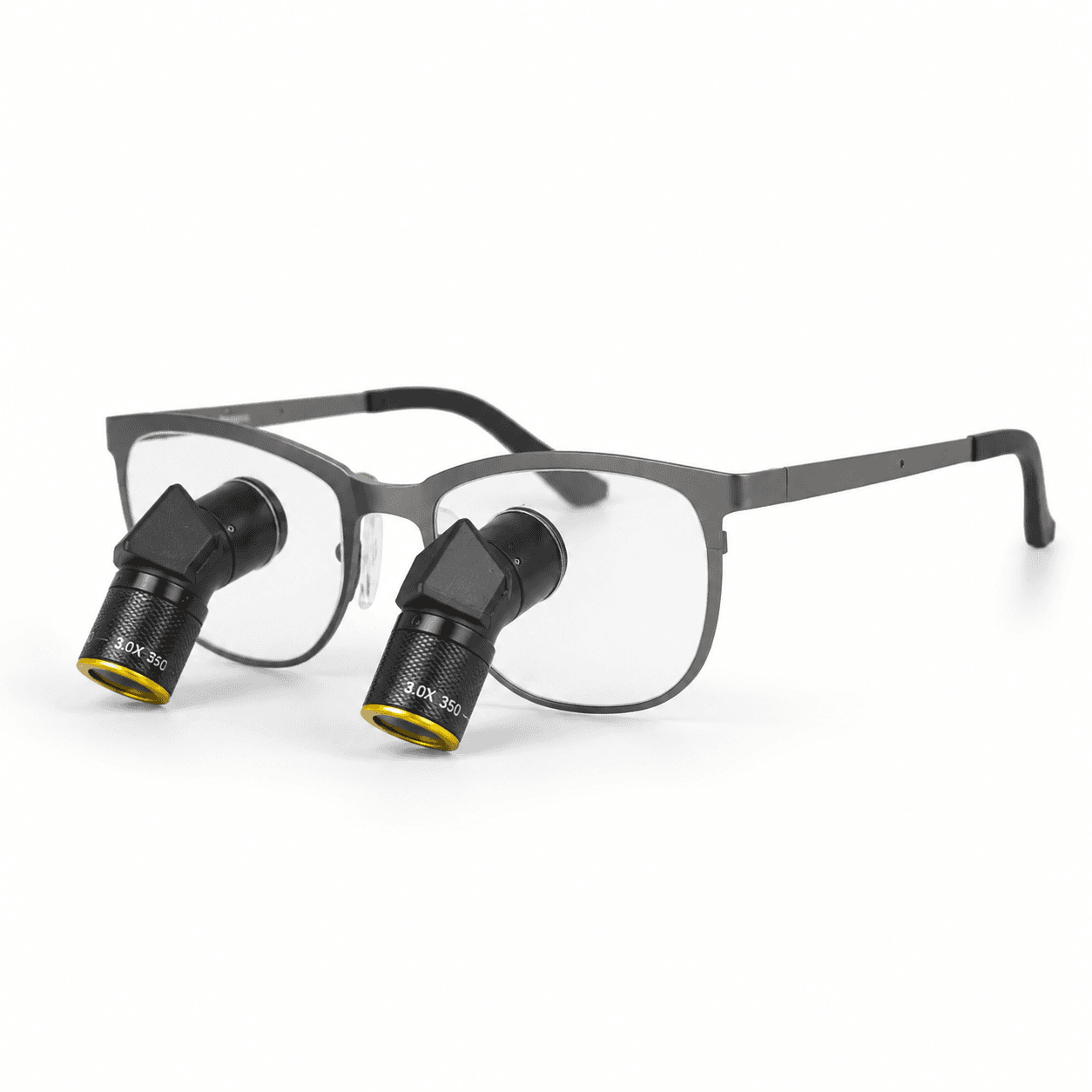
Galileo
From $795Lightweight affordable surgical and dental loupes for students, residents, and everyday clinical use.
A lightweight Galilean option; not an ergonomic prismatic system.
Explore GalileoGeneral surgery
General surgery loupes usually use 2.5x–3.5x magnification for open abdominal, hernia, breast, soft-tissue, and trauma cases. Most general surgeons benefit more from a broad field, correct working distance, and stable posture than from maximum magnification.
We make and sell HeliosX loupes. This is our buying guidance, not an independent product test or paid ranking.
.png&w=3840&q=75)
Galileo · From $795 USD
Your HeliosX shortlist
Compare the optical design, then choose your magnification and frame on the product page.
Lightweight affordable surgical and dental loupes for students, residents, and everyday clinical use.
A lightweight Galilean option; not an ergonomic prismatic system.
Explore GalileoErgonomic prismatic loupes for clinicians who want posture-aware clarity and high-magnification options.
Working distance is fixed to your configuration; magnification is selected at purchase.
Explore ApolloOur lowest-priced Galilean model, with 2.5x, 3.0x, and 3.5x configurations for everyday magnification.
Galilean optics. Choose Apollo or Medusa for a redirected ergonomic view.
Explore NewtonErgonomic prismatic loupes with adjustable working distance for clinicians who change posture between seated and standing work.
Working distance adjusts from 300–600 mm. Magnification does not switch on the loupe.
Explore MedusaStarting prices in USD. Magnification and optional prescription lenses affect the total; shipping and taxes appear at checkout. See all five models.
General surgical visual demands track with the case mix. Open hernia repair and breast work happen in superficial, well-lit fields with structures visible to unaided vision. Open abdominal cases — colectomy, HPB resections, surgical oncology — involve deeper exposure, longer working distance, and dissection around vascular structures where magnification helps. Trauma adds the additional variable of speed and unpredictable anatomy.
Most general surgeons settle on one of three patterns depending on subspecialty focus.
Open abdominal cases pull working distance to the upper end of standard surgical ranges. The operator stands on the table side, the field is 14 to 18 inches away depending on patient size and incision location. Loupes sized to a standard working distance handle this reasonably well, but the fit step is worth attention if the case mix includes bariatric work or very deep retroperitoneal exposure.
For a general surgeon doing four hernias in a morning, the postural cost of standard Galilean loupes is manageable. For a surgeon doing a six-hour HPB resection or a complex retroperitoneal case, the same Galilean loupe forces sustained cervical flexion across hours. Ergonomic prismatic optics pay back most clearly for subspecialty-focused general surgeons whose case mix skews long and deep.
Three HeliosX models cover the general surgical spectrum.
HeliosX is built around a simple mission: make premium magnification more accessible. Compare our published prices and model specifications, then confirm the fit and support terms before committing to a custom pair.
Most general surgeons work at 2.5x–3.5x. Subspecialty-trained surgeons (HPB, transplant, surgical oncology) often move to 3.5x–4.5x for fine vascular and biliary work.
Moderately. The visual benefit for superficial open work is real but not transformative; the postural benefit across years of practice is the better argument. A pair at the $695–$795 range pays back across thousands of cases.
Some do, many do not — trauma timing is unpredictable and the surgeon may have to operate without preparation. Lightweight Galilean loupes (Newton, Galileo) work well for trauma surgeons who keep them ready; ergonomic prismatic is harder to justify because of variable case length.
HPB and transplant fellowship work pushes most surgeons to 3.5x–4.5x for portal dissection, biliary anastomosis, and vascular reconstruction. Apollo at $1,695 ergonomic prismatic is the typical pick.
Galileo at $795 is the default. It covers the magnification range, fits resident budgets, and resident access pricing applies. Apollo at $1,695 is the upgrade for residents committing to HPB, surgical oncology, or transplant tracks.
For deep abdominal and retroperitoneal cases, yes — overhead lighting under-illuminates the deepest part of the field once the operator is positioned. For superficial work (hernia, breast), no. Plan for a loupe-mounted light if your case mix includes regular deep exposure.
Premium magnification. More accessible.
Tell us your specialty, typical procedures, current magnification, and budget. We can help you narrow the options before you order.
Email opens in your mail app: heliosxloupes@gmail.com · Two-year limited warranty
.png&w=3840&q=75)
.png&w=3840&q=75)