
HeliosX field notes
How to Measure Pupillary Distance for Loupes
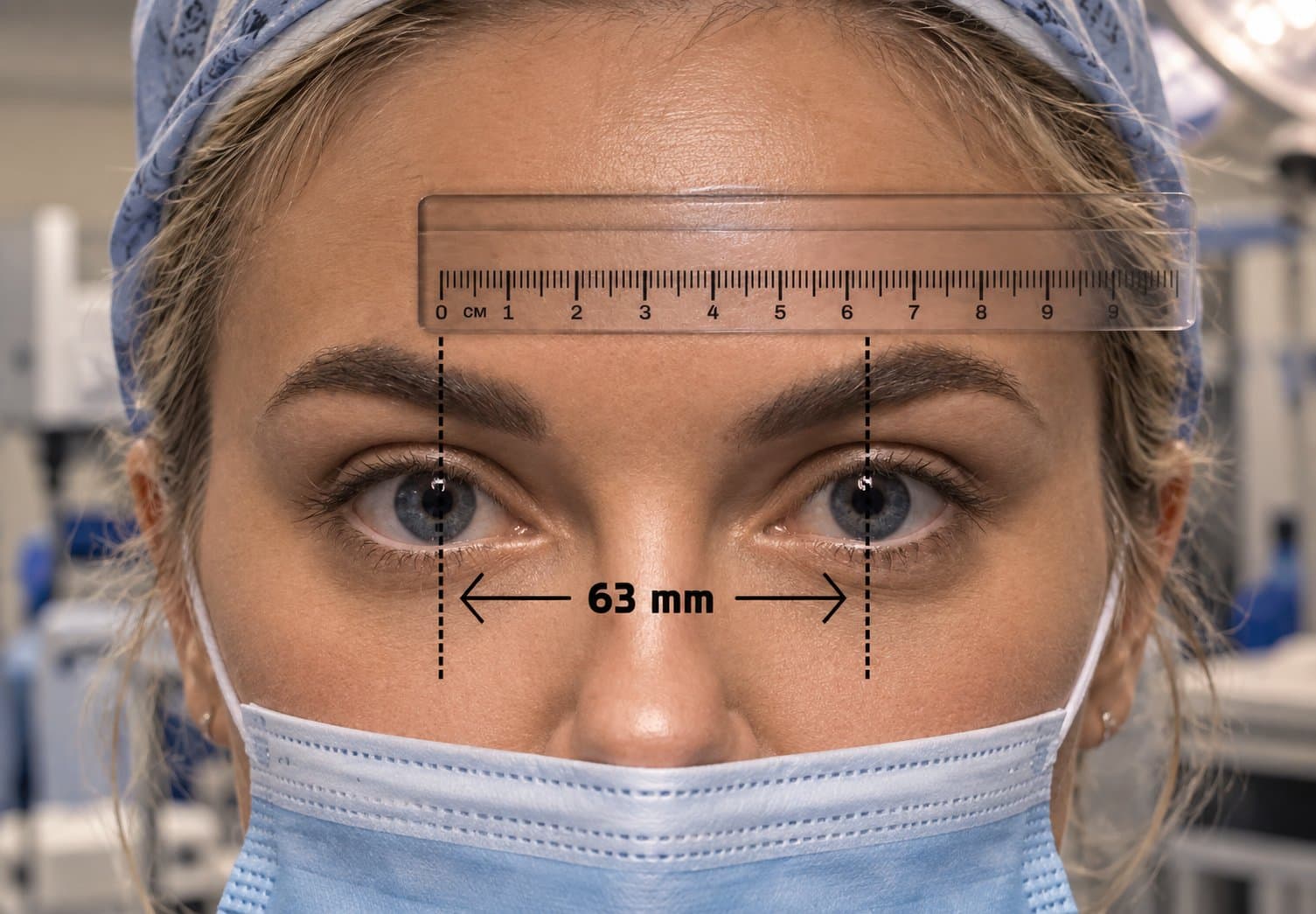
Pupillary distance is the gap between the centres of your pupils, measured in millimetres. It determines where the two optical barrels converge, which makes it the measurement with the least room for error in the entire fitting process. Get working distance slightly wrong and the field feels off. Get PD wrong and your eyes spend every clinical hour quietly compensating.
Why PD carries the tightest tolerance
Loupes are two separate telescopes, and they have to converge on the same point your eyes converge on. When PD is off, the barrels aim slightly wide or slightly narrow of your visual axis, and your extraocular muscles pull the difference. The failure mode is not blur — it is fatigue. That is what makes it insidious: the loupes look fine for the first ten minutes, then produce headaches and eye strain by the end of a long list, and most people blame the magnification rather than the fit. Aim to be within about 1 mm.
- The symptom of bad PD is eye strain and headache, not blurred vision.
- It usually shows up hours in, not immediately.
- Target accuracy is roughly 1 mm.
Three ways to measure, in order of reliability
An optician-measured PD taken on a digital pupilometer is the most reliable source, and if you have had an eye exam in the last couple of years the number is often printed on your prescription already. A well-reviewed smartphone PD app is the next best option and is what most customers use. A ruler held across the brow works, but it is the least forgiving of a rushed measurement. Whichever route you take, measure three times and average — a single reading is where nearly every PD error originates.
- Best: optician or an existing eyeglass prescription.
- Good: a well-reviewed smartphone PD app.
- Workable: a millimetre ruler, carefully, in good light.
What the evidence says about phone apps
A 2023 peer-reviewed study compared leading smartphone PD applications against a digital pupilometer and found they measure accurately enough for confident use. That result is what makes ordering custom-fit loupes online reasonable rather than a gamble — the measurement genuinely does not require someone else in the room. It does require care: steady even light, the phone held level at eye height, and a fixed distant point to look at while the reading is taken.
- Leading apps perform well against clinical instruments.
- Steady, even light and a level phone matter more than which app you pick.
- Look at a fixed point several metres away, not at the camera.
Near PD and distance PD
You may see two numbers on an optical prescription: distance PD and near PD. Near PD is smaller, because your eyes converge inward when focusing on something close. For loupes, the relevant figure follows the working distance the optics are built for, and this is one of the details a fitting process should handle rather than leave to the customer. If your prescription lists both and you are unsure which to send, send both and let us resolve it against your working distance.
- Distance PD is measured looking at a far point; near PD is smaller.
- Send both figures if your prescription lists them.
- The right one depends on the working distance the loupes are built to.
Common mistakes
Measuring while looking at the ruler rather than a distant point is the most frequent error, and it shifts the reading inward by converging your eyes. Taking one measurement and trusting it is the second. Measuring in dim light comes third, because pupil dilation moves the apparent centre. None of these are difficult to avoid, and all of them are easier to avoid than to detect afterwards.
- Do not look at the ruler or the phone while measuring.
- Never rely on a single reading.
- Avoid dim light; dilated pupils shift the apparent centre.
Sources and further reading
Common questions
Can I use a smartphone app to measure PD?
Yes — a well-reviewed PD app gives a reliable measurement at home, and peer-reviewed research validates the approach against clinical pupilometers. Measure in good light, hold the phone level, look at a fixed distant point, and repeat once for confidence.
How accurate does my PD need to be?
Within about 1 mm. PD sets where the two optical barrels converge, so an error shows up as eye strain rather than blur — your eyes compensate for a while and then fatigue. This is why three readings and an average beat one careful attempt.
Is my PD on my glasses prescription?
Often, yes. If you have had an eye exam in the last couple of years, check the prescription before measuring anything — an optician-measured PD taken on a digital pupilometer is more reliable than any at-home method.
What is the difference between near PD and distance PD?
Near PD is smaller, because the eyes converge inward when focusing close. Which figure applies to your loupes depends on the working distance they are built for. If your prescription lists both, send both and we will resolve it.
What happens if my PD is wrong?
The barrels aim slightly off your visual axis and your eye muscles absorb the difference. You get eye strain and headaches over a long day rather than obvious blur, which is why the cause often goes unrecognised. Small errors can sometimes be corrected by adjustment; large ones cannot.
Need help applying this to your setup?
Tell us your specialty, usual working position, and the question you are trying to resolve. Ask before ordering if your configuration is uncertain.