Surgeon wearing HeliosX loupes in a clinical setting

Orthopedic surgery

Orthopedic Surgery Loupes built around real clinical work.

Orthopedic surgery is more visually heterogeneous than most specialties. A surgeon who does total joint replacement in the morning and hand work in the afternoon faces two different magnification problems within the same workday. The loupe choice depends on which subspecialty dominates the case mix and whether ergonomic support across long open cases ranks higher than maximum portability.

01

What orthopedic loupes need to do

The visual problem in orthopedic surgery depends entirely on subspecialty. Total joint work involves large-scale exposure, bone preparation, and component placement — visible to unaided vision and dependent more on alignment than on small-structure visualization. Hand and foot work involves tendons, nerves, and small bones at the limit of unaided sight. Spine work falls somewhere between, with deep cavity exposure adding lighting demands. A single magnification recommendation does not cover the specialty.

Total joint replacement (hip, knee, shoulder) — 2.5x–3.0x for component alignment, soft tissue handling, and capsular work.
Hand and wrist surgery — 3.5x–5.0x for tendon repair, nerve work, and small-bone fixation.
Foot and ankle surgery — 3.0x–4.0x for midfoot and forefoot reconstructions, tendon work, fixation.
Spine surgery — 3.0x–4.5x; covered in a dedicated /spine-surgery-loupes page.
Pediatric orthopedics — 3.0x–4.5x typical for small-anatomy fixation and limb-reconstruction work.

02

Choosing magnification by subspecialty focus

Three configurations cover most orthopedic surgical preferences.

General orthopedics and arthroplasty — Galileo at 2.5x–3.5x is the default; broad field for exposure work.
Hand and small-anatomy focus — Apollo or Kepler at 4.0x–5.0x covers tendon, nerve, and small-bone work.
Mixed case mix (arthroplasty plus hand call) — Medusa at 3.0x–8.5x adjustable working distance is the single-pair pick.

03

Hand surgery deserves its own conversation

Hand surgeons often operate at the higher end of orthopedic magnification because the structures involved — flexor and extensor tendons, digital nerves, vascular pedicles — sit at the lower limit of unaided vision. Hand work also frequently includes microsurgical components (digital replantation, microvascular anastomosis) that push into 5.0x–6.0x or operating microscope territory. A general orthopedic loupe is not adequate for a hand specialist.

Flexor tendon repair at 4.0x–5.0x improves suture placement consistency.
Digital nerve repair frequently moves to the operating microscope above 5.0x.
Hand fracture fixation with small implants benefits from 3.5x–4.5x.
Hand surgeons with microvascular components in their practice often own both a hand-focused loupe and a microscope.

04

Posture and long orthopedic cases

Open orthopedic cases — revision arthroplasty, complex spine, fracture reconstruction — can run six hours and beyond. The cumulative postural load is the leading driver of late-career neck and back complaints in orthopedic surgeons. Ergonomic prismatic optics reduce the sustained cervical flexion that dominates that strain pattern, particularly for surgeons who stand for cases rather than sit.

Standing-position open cases drive sustained neck and shoulder load.
Ergonomic prismatic designs raise the viewing angle and reduce head-tilt across long cases.
The benefit is most visible in surgeons whose case mix includes weekly revision or trauma reconstruction.

05

HeliosX models for orthopedic practice

Four HeliosX models cover the orthopedic spectrum depending on subspecialty.

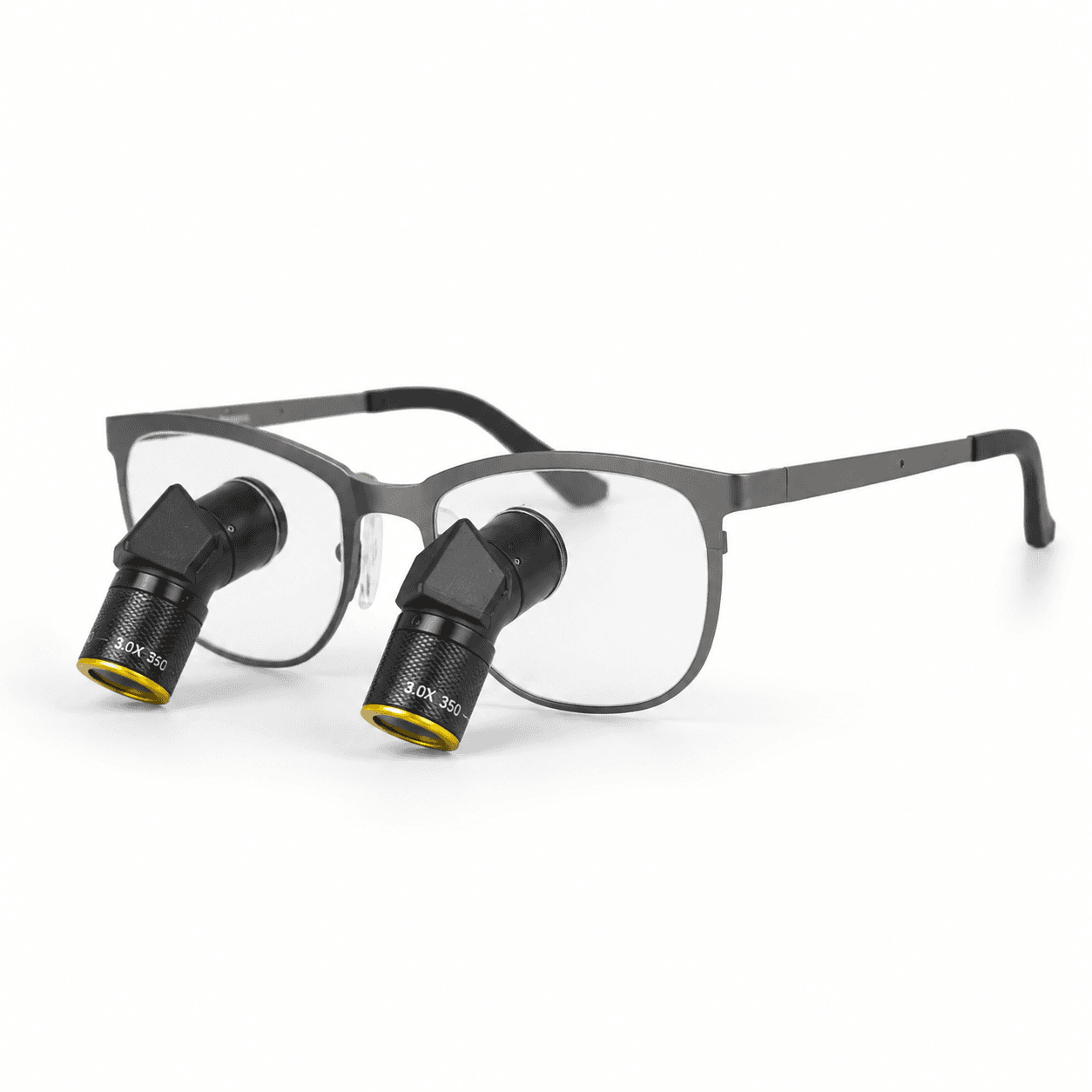
Galileo ($795) — lightweight Galilean at 2.5x–3.5x. The default for general orthopedics, joint replacement, and arthroplasty-focused practice.
Apollo ($1,695) — ergonomic prismatic at 3.0x–6.0x. The pick for hand specialists and for arthroplasty surgeons who want posture support across long cases.
Kepler ($1,195) — high-magnification prismatic at 4.0x–6.0x. Strong for hand and small-anatomy specialists who do not need adjustable working distance.
Medusa ($1,695) — ergonomic prismatic with adjustable working distance, 3.0x–8.5x. The pick for surgeons with mixed arthroplasty and hand-call case mix.

06

Affordable without feeling cheap

A lower price should not force clinicians into vague specs, weak fit support, or disposable optics. HeliosX is built around affordable premium value: clear model roles, fair pricing, and guidance before production begins. A 2004 peer-reviewed survey of 148 specialists and senior trainees (Jarrett PM, Microsurgery 2004;24:420–422) documented the intraoperative magnification ranges that real surgeons actually use — useful context when comparing brand claims against case-mix reality.

Source: Jarrett PM. Intraoperative magnification: who uses it? Microsurgery. 2004;24:420–422.

Transparent product roles and price ranges.
Measurement guidance for pupillary distance and working distance.
Education-first buying support for students, residents, dentists, and surgeons.

Buyer criteria

Choose by work, posture, and fit.

A useful loupe guide answers the real buying question. Start with the procedures you perform, then compare optics around posture, magnification, fit support, and price.

Workflow

Which procedures, appointments, or cases will these loupes support most often?

Posture

Do you need ergonomic prismatic viewing or adjustable working distance?

Magnification

How much detail do you need before field of view becomes too narrow?

Fit

Do you have accurate pupillary distance, working distance, and prescription details?

Budget

Are you buying for school, residency, practice, or a focused upgrade?

Support

Can you easily get help with measurements, shipping, prescription, and setup?

Side-by-side

Comparison snapshot

Side-by-side comparison of HeliosX and Typical legacy orthopedic loupe across 5 positioning factors.
FeatureHeliosXTypical legacy orthopedic loupe
General orthopedics and arthroplastyGalileo 2.5x–3.5xStandard orthopedic Galilean
Hand and small-anatomy workApollo or Kepler at 4.0x–5.0xSpecialist prismatic or microscope
Mixed arthroplasty + hand callMedusa 3.0x–8.5x adjustableTwo pairs or fixed-range prismatic
Long-case ergonomic supportApollo and Medusa from $1,695$3,500–$5,500+
Resident access pricingDocumented across lineupVaries by program

For general orthopedics and arthroplasty, Galileo at $795 covers the magnification range without overpaying. Hand and small-anatomy specialists move to Apollo at $1,695 or Kepler at $1,195. Surgeons with mixed case mix and long-case posture concerns choose Medusa at $1,695.

Questions

Quick answers

What magnification do orthopedic surgeons use?

It depends on subspecialty. General orthopedics and arthroplasty use 2.5x–3.5x; hand and small-anatomy work uses 3.5x–5.0x; foot and ankle surgery 3.0x–4.0x; spine surgery 3.0x–4.5x. A single magnification recommendation does not cover the specialty.

Do orthopedic surgeons need loupes for joint replacement?

Many do not; some do. Total joint work is large-scale exposure where alignment is the variable that matters more than magnification. The case for loupes in arthroplasty is moderate, while the case for loupes in hand or small-anatomy work is strong.

What loupes do hand surgeons use?

Most hand surgeons work at 4.0x–5.0x. Microvascular components push to 5.0x–6.0x or the operating microscope. Apollo at $1,695 ergonomic prismatic and Kepler at $1,195 high-magnification prismatic both cover the hand range.

Are ergonomic loupes worth it for orthopedic surgeons?

Yes for surgeons whose case mix includes long open cases — revision arthroplasty, complex spine, trauma reconstruction. Standing-position work multiplies cumulative postural load; ergonomic prismatic optics reduce sustained cervical flexion measurably.

Which HeliosX loupe is best for orthopedic residents?

Galileo at $795 is the default for residents — covers the general orthopedic range and resident access pricing applies. Apollo at $1,695 is the upgrade for residents who already know they are heading into hand or microsurgical practice.

Do orthopedic surgeons need a headlight?

For deep cavity work — revision arthroplasty, complex spine, posterior shoulder — yes. For most hand, foot, and superficial work, overhead surgical lighting is adequate. Plan for a loupe-mounted LED light if your case mix includes deep open cases.