Surgeon wearing HeliosX loupes in a clinical setting

Review

HeliosX Loupes Review built around real clinical work.

HeliosX is a direct-to-clinician surgical and dental loupe brand priced $695 to $1,695 across five product lines. The pitch — premium optical glass and ergonomic prismatic options at roughly a third of legacy-brand prices — is unusual enough that most buyers want to know what the catch is. This review covers the optics, the fit process, who the lineup is built for, and the tradeoffs you should factor in before ordering.

01

Who HeliosX is built for

HeliosX makes the most sense for clinicians who would otherwise be priced out of ergonomic prismatic optics, or who refuse to spend $4,000 on a Galilean loupe they could get the optical equivalent of for under $1,000. The audience leans residents, dental and medical students, hygienists, attendings replacing aging loupes, and surgeons buying their first ergonomic prismatic pair without a department to absorb the bill.

Best fit: surgical and dental residents, students, hygienists, and attendings paying out of pocket.
Strong fit: surgeons buying their first ergonomic prismatic system at 3.0x–6.0x.
Weaker fit: clinicians who already own a legacy brand’s headlight ecosystem and want bundle continuity.

02

The lineup at a glance

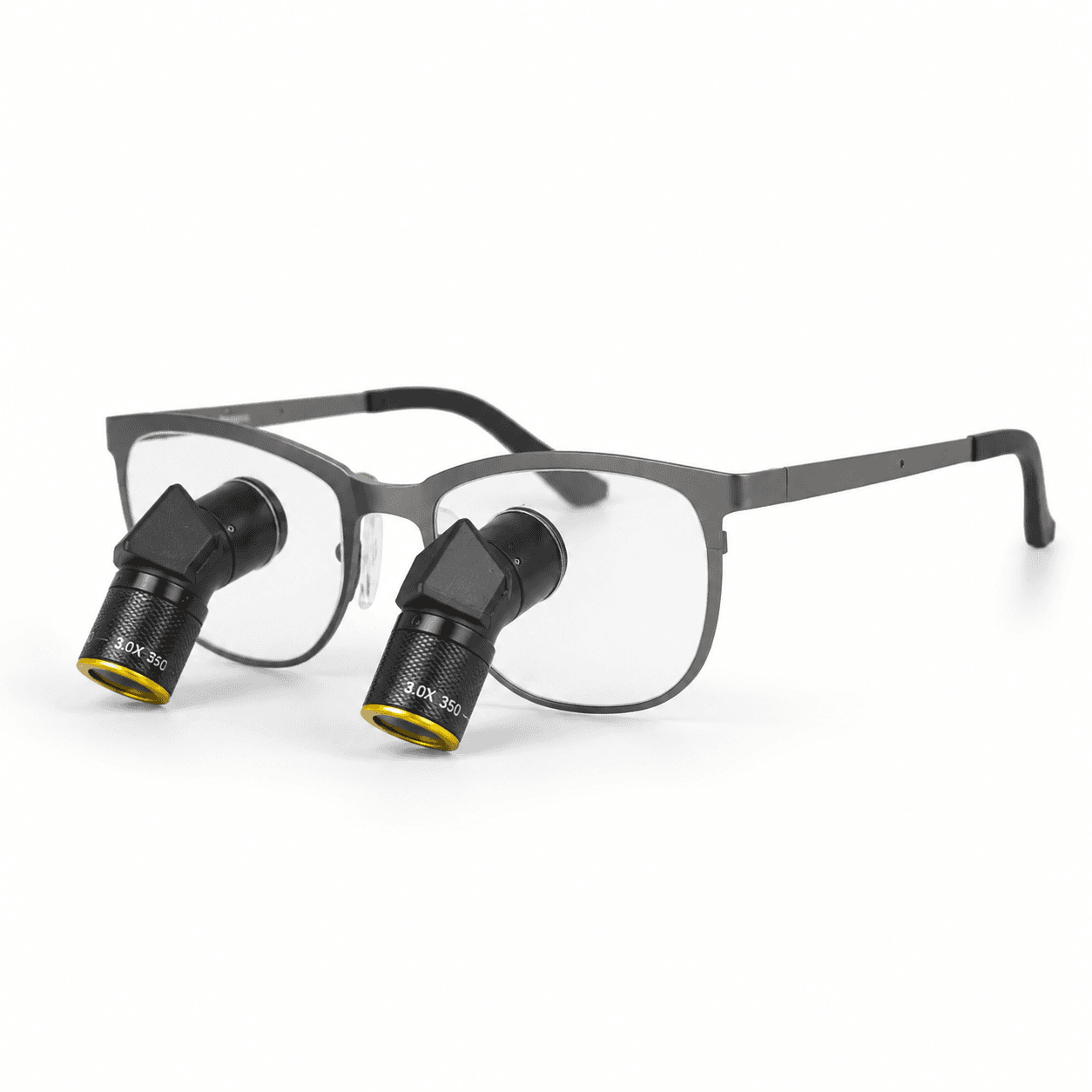
Five models cover the working range most clinicians need. Two are Galilean and lightweight; three are prismatic, with one (Medusa) adding adjustable working distance. Prices are published; there is no quote funnel.

Newton ($695) — ultra-light Galilean, 2.5x to 3.5x. Built for hygienists, students, and long-day comfort.
Galileo ($795) — lightweight Galilean, 2.5x to 3.5x. The everyday clinical and broad-training pick.
Kepler ($1,195) — high-magnification prismatic, 4.0x to 6.0x. Microsurgery, plastics, ENT, detail-intensive work.
Apollo ($1,695) — ergonomic prismatic with fixed working distance, 3.0x to 6.0x.
Medusa ($1,695) — ergonomic prismatic with adjustable working distance, 3.0x to 8.5x. The widest range in the lineup.

03

Where HeliosX outperforms legacy brands

Three things separate HeliosX from the brands its prices undercut, and they are the three things that actually matter once the loupes are on your face.

Optical glass at every price tier. Multi-layer-coated glass and rigid metal barrels are standard on the $695 Newton, not reserved for the $1,695 ergonomic prismatic flagships. Most legacy lineups reserve premium optics for the top of their pricing.
Ergonomic prismatic at a price normally reserved for entry Galilean. Medusa and Apollo deliver posture-aware viewing for less than what most legacy brands charge for their flagship Galilean. That single fact is the strongest part of the pitch.
Published pricing and direct shipping. Every starting price is on the site. There is no rep, no quote, no dealer markup, no scheduled phone call to find out what a pair costs.

04

Where HeliosX is still scaling

Three honest tradeoffs to weigh before ordering. None is a dealbreaker for most buyers, but each is worth knowing.

No in-person fitting events. Measurement happens via guided email workflow after checkout — accurate, but not the same as a rep visiting a dental school or hospital. If you want hands-on fitting before you commit, HeliosX is direct-ship only.
Smaller catalog footprint than legacy brands. Five product lines is intentional and keeps the buying decision readable, but if you want fifteen frame families and a dozen light bundles to choose from, larger brands offer that breadth.
Newer brand with less institutional history. Established names have decades of dental-school exclusives, residency-program relationships, and word-of-mouth in the OR. HeliosX has been building that footprint at a faster rate than most challenger brands, but it is still earlier in its arc.

05

The fit and buying process

The order flow is short on purpose. You select a model and magnification on the product page, pay, and receive a measurement email within the day. The measurement step walks you through pupillary distance, working distance, prescription details, and posture preferences. Production begins after measurements are confirmed; orders are fully refundable up to that point. Standard turnaround from measurement submission to delivery is roughly three to five weeks in the US and Canada.

Step 1: choose model and magnification; pay; receive measurement email.
Step 2: submit PD, working distance, prescription, posture notes via the linked form.
Step 3: HeliosX confirms the fit detail; production begins.
Step 4: shipping in roughly 3 to 5 weeks for US and Canada orders.
Refund window: full refund any time before measurements are submitted. 30-day return after delivery for orders in original condition.

06

Affordable without feeling cheap

A lower price should not force clinicians into vague specs, weak fit support, or disposable optics. HeliosX is built around affordable premium value: clear model roles, fair pricing, and guidance before production begins. A 2004 peer-reviewed survey of 148 specialists and senior trainees (Jarrett PM, Microsurgery 2004;24:420–422) documented the intraoperative magnification ranges that real surgeons actually use — useful context when comparing brand claims against case-mix reality.

Source: Jarrett PM. Intraoperative magnification: who uses it? Microsurgery. 2004;24:420–422.

Transparent product roles and price ranges.
Measurement guidance for pupillary distance and working distance.
Education-first buying support for students, residents, dentists, and surgeons.

Buyer criteria

Choose by work, posture, and fit.

A useful loupe guide answers the real buying question. Start with the procedures you perform, then compare optics around posture, magnification, fit support, and price.

Workflow

Which procedures, appointments, or cases will these loupes support most often?

Posture

Do you need ergonomic prismatic viewing or adjustable working distance?

Magnification

How much detail do you need before field of view becomes too narrow?

Fit

Do you have accurate pupillary distance, working distance, and prescription details?

Budget

Are you buying for school, residency, practice, or a focused upgrade?

Support

Can you easily get help with measurements, shipping, prescription, and setup?

Side-by-side

Comparison snapshot

Side-by-side comparison of HeliosX and Typical legacy loupe brand across 8 positioning factors.
FeatureHeliosXTypical legacy loupe brand
Starting price$695 (Newton) to $1,695 (Medusa, Apollo)$2,000 to $5,500+ for equivalent tier
Buying experienceDirect-ship; published prices; one-business-day supportQuote-based pricing; dealer-rep call; in-person fitting events
Lineup size5 product lines, intentionally focused10–20+ models across multiple sub-brands
Optical glass tierPremium multi-layer-coated standard across all 5 modelsPremium optics typically reserved for top-tier models
Ergonomic prismatic price$1,695 (Medusa, Apollo)Commonly $3,500–$5,500+
Headlight integrationSold separately; no proprietary bundleOften bundled with proprietary headlight systems
Resident / student access pricingDocumented discounts available on requestDental-school programs common; surgical-resident access varies
Refund windowFull refund before measurements submitted; 30-day return after deliveryVaries; restocking fees common

HeliosX is the right call if you want premium optical glass, ergonomic prismatic options, and transparent pricing without a dealer relationship. If your priority is an in-person fitting visit, an integrated headlight ecosystem, or a name your residency program already recognizes, a legacy brand may still be worth the premium for you. For most surgical and dental buyers paying out of pocket — especially residents, students, and attendings replacing aging loupes — the value math is hard to argue with.

Questions

Quick answers

Are HeliosX loupes actually good?

Yes. The optical glass is multi-layer-coated, the barrels are rigid metal, and the ergonomic prismatic lineup covers 3.0x to 8.5x magnification with custom IPD and working-distance fitting on every order. The performance is comparable to legacy brands at two to three times the price; the cost difference is in distribution, not the loupes themselves.

Are HeliosX loupes a real brand or a generic rebrand?

HeliosX is a real direct-to-clinician brand with its own product lines (Medusa, Apollo, Kepler, Galileo, Newton), its own frame catalogs, and its own support team. The lineup is engineered as HeliosX rather than rebranded generic optics, which is one reason the lineup is small and focused rather than expansive.

How long do HeliosX loupes last?

Build construction targets the same five-to-ten-year service life as legacy surgical loupes — rigid metal barrels, premium glass, multi-layer coatings. The warranty includes replacement and lens-update paths, which matters more than launch-day specs over a five-year ownership window.

Does HeliosX offer a warranty?

Yes. Every order ships with a warranty that covers manufacturing defects and optical performance, plus replacement and lens-update paths for prescription changes. See /warranty for the full policy and how claims are handled.

Why are HeliosX loupes so much cheaper than legacy brands?

Direct-to-clinician shipping skips dealer markup, which typically runs 30 to 50 percent of the retail price on legacy surgical loupes. The savings are structural — same glass, same fit precision, no rep layer in between. See the pricing guide at /how-much-do-surgical-loupes-cost for the full breakdown.

What if my loupes do not fit when they arrive?

Orders are fully refundable before measurements are submitted. After measurement-and-production, the 30-day return window applies to orders in original condition. Fit adjustments and lens updates are handled under the warranty for issues that emerge after delivery.

Where are HeliosX loupes manufactured?

HeliosX manufactures through a combination of optical and frame suppliers vetted for surgical-grade build and coating standards. The supply chain is the same tier used by major legacy brands; the difference is who else gets paid before the loupes reach the clinician.