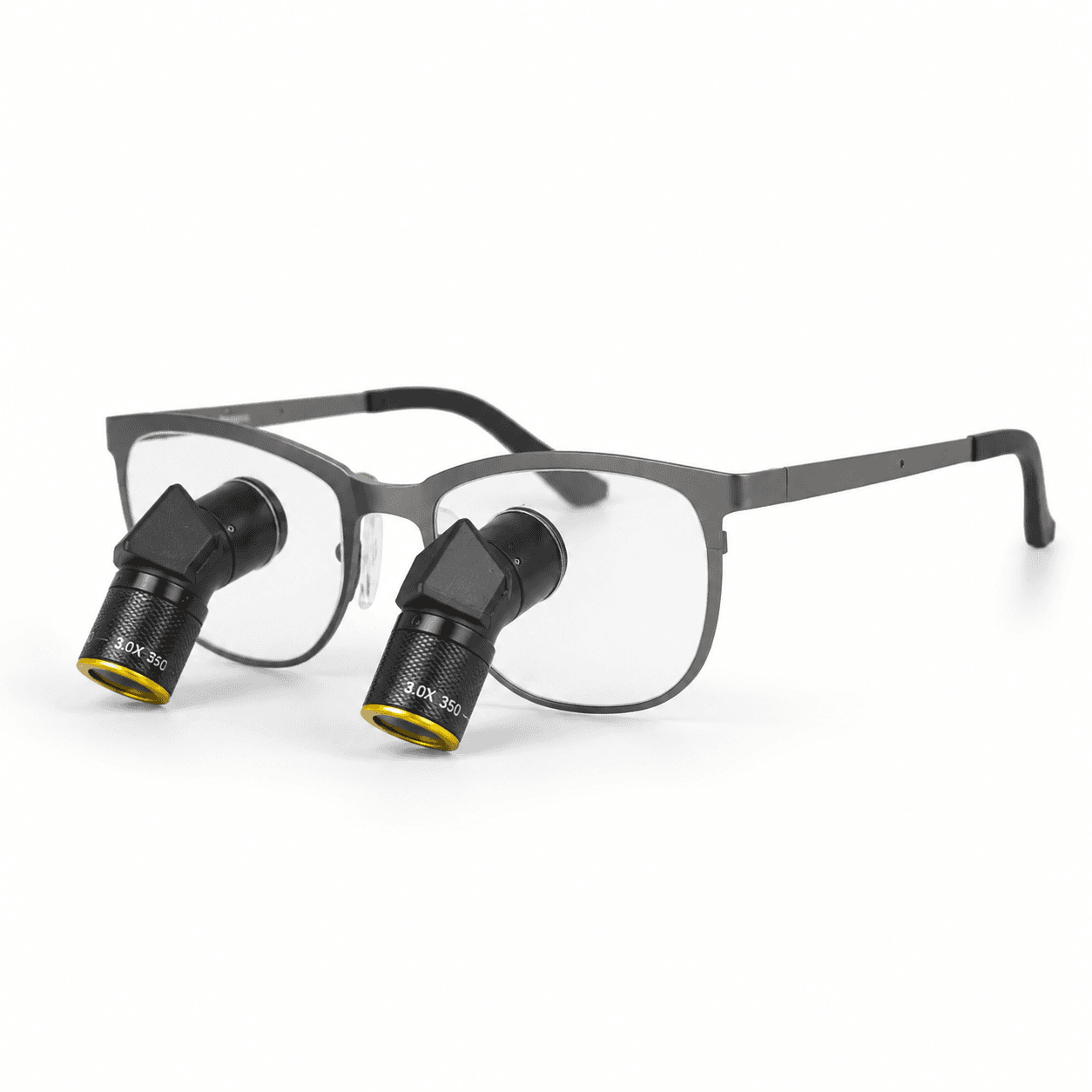
Kepler
From $1,195Conventional prismatic loupes for higher-magnification work, available in 4.0x, 5.0x, and 6.0x.
Conventional prismatic optics. Choose Apollo or Medusa for ergonomic viewing.
Explore KeplerNeurosurgery loupes
Loupes do part of the work in neurosurgery and not the rest of it. They cover exposure, closure, much spine work and a good deal of peripheral nerve surgery. They do not replace an operating microscope where one is indicated, and any vendor telling you otherwise is selling rather than advising. What follows is where the line sits and how to choose for the work on your side of it.
We make and sell HeliosX loupes. This is our buying guidance, not an independent product test or paid ranking.
.png&w=3840&q=75)
Kepler · From $1,195 USD
Your HeliosX shortlist
Compare the optical design, then choose your magnification and frame on the product page.
Conventional prismatic loupes for higher-magnification work, available in 4.0x, 5.0x, and 6.0x.
Conventional prismatic optics. Choose Apollo or Medusa for ergonomic viewing.
Explore KeplerErgonomic prismatic loupes for clinicians who want posture-aware clarity and high-magnification options.
Working distance is fixed to your configuration; magnification is selected at purchase.
Explore ApolloErgonomic prismatic loupes with adjustable working distance for clinicians who change posture between seated and standing work.
Working distance adjusts from 300–600 mm. Magnification does not switch on the loupe.
Explore MedusaStarting prices in USD. Magnification and optional prescription lenses affect the total; shipping and taxes appear at checkout. See all five models.
This is the decision that matters most and the one most buying guides avoid. An operating microscope offers coaxial illumination down a narrow corridor, magnification well beyond any loupe, and a stable optical axis that does not move with your head. Loupes offer speed, freedom of movement and no setup. Neither substitutes for the other. Where your service, your department protocol or the procedure itself calls for the microscope, that decision is not an optical preference and loupes do not change it.
The line above is not a HeliosX opinion. The StatPearls clinical reference on microdiscectomy, the most common indication for spinal surgery, states that because of its collinear light and magnification an operating microscope is preferred, and that magnifying loupes with a headlight may also be used. A 2014 Cochrane systematic review defines microdiscectomy and open discectomy as being performed with or without the aid of headlight loupe or microscope magnification. Read together: for this procedure family, loupes with a headlight are an accepted magnification route, and the microscope remains preferred.
If you are searching for the best surgical loupes for neurosurgery, the honest answer depends on which half of the work you mean, so start from the section above. For the half loupes cover, most neurosurgical buyers land in one of three places. This compares published products and buying terms. It is not a hands-on ranking of optical quality.
Higher is not automatically better, and in neurosurgery the tradeoff bites harder than in most specialties. Every step up narrows the field and shortens the depth of field, so a deep corridor that was workable at 4.0x can become a constant refocusing exercise at 6.0x. Choose the lowest magnification that resolves the structure you need to see, then confirm you still have enough depth to work through the corridor rather than at a single plane.
Neurosurgical cases run long and much of the work happens standing, often with the head held in one position for extended periods. Working distance sets your neck angle more than any other specification. Measure standing, at your real table height, in the posture you actually hold rather than the one you would like to. If you alternate between seated spine work and standing cranial work, a fixed working distance will suit one and compromise the other.
A pair that feels fine at the start of a case can be the thing you notice four hours in. Longer working distances need larger optical assemblies, so the specification that fixes your posture also adds the weight you carry. Weigh the finished configuration rather than the frame: prescription lenses and a headlight both add to the front load, and the light is where most of the surprise sits.
HeliosX exists to make premium magnification more accessible, so prices are published and the configuration is visible before you order. For neurosurgery the realistic choice is between conventional prismatic detail and ergonomic prismatic viewing for long cases.
Most loupe-appropriate neurosurgical work sits between 3.5x and 6.0x. Higher magnification narrows the field and shortens depth of field, which is a real problem in a deep corridor. Choose the lowest magnification that resolves what you need to see.
No. A microscope offers coaxial illumination down a narrow corridor, magnification beyond any loupe, and an optical axis that does not move with your head. Loupes cover exposure, closure, much spine work and peripheral nerve surgery. Where the microscope is indicated, loupes do not change that.
Kepler covers conventional prismatic 4.0x to 6.0x from $1,195. Apollo offers ergonomic prismatic viewing from $1,695 for long cases where head posture matters. Medusa adds adjustable working distance from 300 to 600 mm, which suits alternating seated and standing work.
In any deep corridor, illumination becomes limiting before magnification does. Overhead theatre lighting is frequently blocked by your own head and hands at depth. If you buy a light, decide before production because the mount is fitted to the loupe.
If you are assisting and closing regularly, yes, and buying early gets the adaptation done before it costs you anything. Measure standing at the table height you actually work at, and choose the lower end of the magnification range for your first pair.
Premium magnification. More accessible.
Tell us your specialty, typical procedures, current magnification, and budget. We can help you narrow the options before you order.
Email opens in your mail app: heliosxloupes@gmail.com · Two-year limited warranty
.png&w=3840&q=75)