
Galileo
From $795The lightweight everyday standard, favored by dentists, hygienists and surgeons in 110+ countries: Galilean 2.5x–3.5x, six frame styles included.
A lightweight Galilean option; not an ergonomic prismatic system.
Explore GalileoHair restoration loupes
Short answer: Most hair restoration work is done at 3.0x–4.0x. Technicians placing grafts favor Galilean 3.0x–3.5x for its wide, deep field; FUE extraction and site making are usually done at 3.5x–5.0x. HeliosX Galileo starts at $795 and Kepler 4.0x–6.0x at $1,195, and Medusa adds an adjustable 300–600 mm working distance for teams who sit and stand through a long case. Every pair is custom-built, with a lifetime warranty.
HeliosX is the world standard in custom ergonomic loupes, supplied to clinicians, teaching hospitals and universities in more than 110 countries. A hair transplant is thousands of repetitions of the same small act: score, extract, check, place. A session can run six to eight hours, and every graft is a follicular unit of one to four hairs handled by its edges. The whole team works under magnification, and the right loupes decide how well each person sees the follicle and how they feel at graft three thousand.
Guidance from the HeliosX loupe specialists.
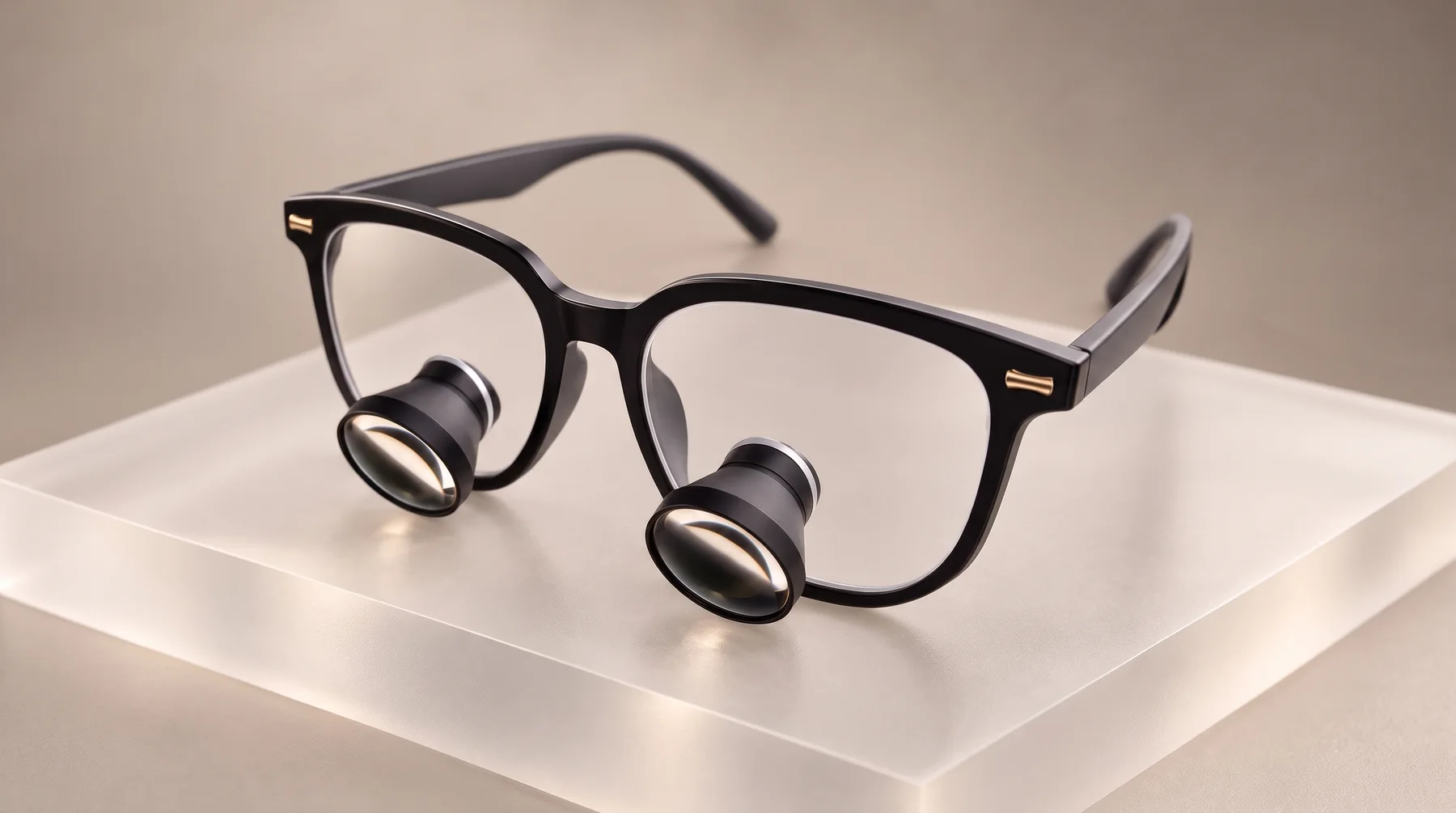
Galileo · From $795 USD
Common starting points. Choose for the work you do most often, then confirm the view at your own working distance.
| Procedure | Magnification | Working distance | HeliosX starting point |
|---|---|---|---|
| FUE punch scoring and extraction | 3.5x–5.0x | 30–45 cm, seated behind the patient | Kepler at 4.0x, from $1,195 |
| Recipient site making | 3.0x–4.0x | 35–45 cm | Galileo at 3.5x |
| Graft placement | 3.0x–3.5x | 30–45 cm | Galileo at 3.0x, from $795 |
| Graft inspection, counting and trimming | 3.5x–5.0x | 30–40 cm at the bench | Kepler at 5.0x |
| Hairline design, eyebrow and beard work | 3.5x–4.0x | 35–45 cm | Medusa at 4.0x |
| Strip (FUT) slivering and dissection | Stereo microscope | Bench | Loupes for placement; the microscope leads for strip dissection |
Why HeliosX
HeliosX is regarded as a leader and innovator in surgical and dental magnification, setting the standard for ergonomic prismatic and lightweight Galilean loupes. HeliosX loupes are built from the highest-grade optical glass and premium lightweight metals: bright, true-color optics in frames that stay light and form-fitting through the longest case.
Ask a HeliosX loupe specialist anything, from the right magnification for your specialty to weight, working distance and lighting. We have answered it at hundreds of expos.
Your HeliosX shortlist
Compare the optical design, then choose your magnification and frame on the product page.
The lightweight everyday standard, favored by dentists, hygienists and surgeons in 110+ countries: Galilean 2.5x–3.5x, six frame styles included.
A lightweight Galilean option; not an ergonomic prismatic system.
Explore GalileoHigh-magnification prismatic loupes at 4.0x, 5.0x and 6.0x, favored by surgeons worldwide for fine detail. Custom-built, lifetime warranty.
Conventional prismatic optics. Choose Apollo or Medusa for ergonomic viewing.
Explore KeplerThe adjustable ergonomic prismatic loupe surgeons in 110+ countries choose when they sit and stand: 3.0x–8.5x, working distance 300–600 mm, custom-built.
Working distance adjusts from 300–600 mm. Magnification does not switch on the loupe.
Explore MedusaStarting prices in USD. Magnification and optional prescription lenses affect the total; shipping and taxes appear at checkout. See all five models.
Each stage asks for something different. Extraction needs detail, so you can read the exit angle of the hair and centre the punch. Placement needs field and depth, so you can move quickly from site to site without refocusing. That is why many clinics equip the surgeon and the placing team differently.
Technicians place and check more grafts in a day than anyone else in the room. The loupe that works is the one that stays light on the nose and sharp across a full row of sites. Galileo at 3.0x or 3.5x gives a wide field and deep focus in a lightweight frame, from $795; Newton offers the same magnifications at 40–50 g with the frame, from $695.
Extraction and site making reward more magnification. Kepler is the conventional prismatic loupe for 4.0x, 5.0x and 6.0x detail, from $1,195. Surgeons who score and extract for hours often choose an ergonomic prismatic pair instead: Medusa covers 3.0x–8.5x and its working distance adjusts from 300 to 600 mm as you move around the scalp.
Extraction from the donor area is done leaning over the back of a prone or seated patient, often for hours without a break. Working distance and the angle of the optics matter more here than in almost any other field. Build the loupe to the distance at which you sit upright, and consider ergonomic prismatic optics that let your eyes look down while your head stays up.
Follicles sit in small, shadowed fields, and blood on the scalp absorbs light. A loupe-mounted light keeps the beam on your line of sight. Polaris (50,000 lux, 10 g at the frame, from $265) suits 3.0x–3.5x; Vega (70,000 lux, from $365) suits 4.0x; Rigel (100,000 lux) suits 5.0x–6.0x.
Every HeliosX loupe is built for one person. You send two numbers, your pupillary distance and the working distance you measure at your own procedure chair, and a loupe specialist reviews them before anything is made. Prices are published, frame choices are included, and prescription lenses can be built in for $200.
For graft placement, HeliosX Galileo at 3.0x–3.5x (from $795). For FUE extraction and site making, Kepler at 4.0x–5.0x (from $1,195) or Medusa, which adds ergonomic optics and an adjustable working distance.
Most FUE extraction is done at 3.5x–5.0x. That shows the hair’s exit angle and the punch position clearly enough to limit transection while keeping a workable field.
3.0x–3.5x. A Galilean loupe at that power has a wide field and deep focus, which keeps placement fast and comfortable over thousands of grafts.
Not for strip dissection, where the stereo microscope leads. Loupes are the standard tool for FUE extraction, site making, placement and quick graft checks.
Yes. Each pair is built to one person’s measurements, so we take pupillary and working distance for every team member and plan magnification by role. Contact a loupe specialist: Contact.
Yes for extraction and site making. Polaris (50,000 lux, 10 g at the frame, from $265) suits 3.0x–3.5x, and brighter lights are matched to higher magnification.
Premium magnification. More accessible.
Tell us your specialty, typical procedures, current magnification, and budget. We can help you narrow the options before you order.
Email opens in your mail app: heliosxloupes@gmail.com · Limited lifetime warranty

