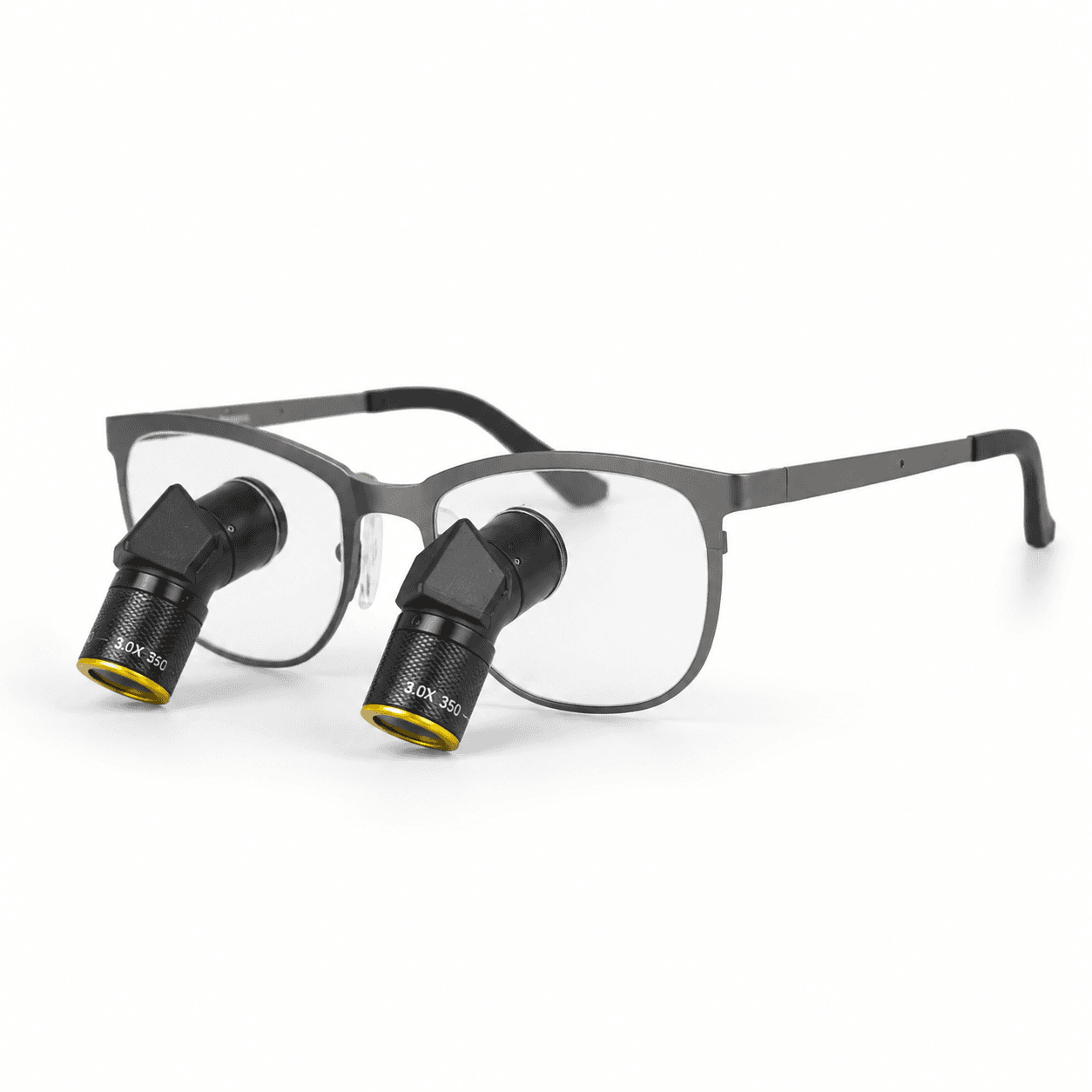
Newton
From $695Our lowest-priced Galilean model, with 2.5x, 3.0x, and 3.5x configurations for everyday magnification.
Galilean optics. Choose Apollo or Medusa for a redirected ergonomic view.
Explore NewtonHeliosX buying guide
Most students and residents should start with 2.5x–3.5x Galilean loupes, move to prismatic optics only when their cases need 4.0x or more, and consider ergonomic prismatic loupes when neck posture is the main problem. Decide in this order: magnification, optical design, working distance, then budget. The brand comes last.
We make and sell HeliosX loupes. This is our buying guidance, not an independent product test or paid ranking.
.png&w=3840&q=75)
Newton · From $695 USD
Your HeliosX shortlist
Compare the optical design, then choose your magnification and frame on the product page.
Our lowest-priced Galilean model, with 2.5x, 3.0x, and 3.5x configurations for everyday magnification.
Galilean optics. Choose Apollo or Medusa for a redirected ergonomic view.
Explore NewtonConventional prismatic loupes for higher-magnification work, available in 4.0x, 5.0x, and 6.0x.
Conventional prismatic optics. Choose Apollo or Medusa for ergonomic viewing.
Explore KeplerErgonomic prismatic loupes for clinicians who want posture-aware clarity and high-magnification options.
Working distance is fixed to your configuration; magnification is selected at purchase.
Explore ApolloErgonomic prismatic loupes with adjustable working distance for clinicians who change posture between seated and standing work.
Working distance adjusts from 300–600 mm. Magnification does not switch on the loupe.
Explore MedusaStarting prices in USD. Magnification and optional prescription lenses affect the total; shipping and taxes appear at checkout. See all five models.
Buy for the cases you do most often, not the most demanding case you can imagine. Higher magnification narrows your field of view and depth of field, so more is not automatically better. Use these as common starting points, then confirm with the surgeons you train with.
Source: Loupe magnification guide
Galilean loupes are light and practical up to about 3.5x. Conventional prismatic loupes reach higher magnification, usually at more weight. Ergonomic prismatic loupes redirect your line of sight so you can keep your head more upright; "prismatic" alone does not mean ergonomic.
Working distance is the gap between your eyes and the field when you stand or sit in your normal operating posture. A loupe built for the wrong distance forces you to lean in or pull back to stay in focus, which defeats the point. Measure in the posture you really use, and if you switch between seated and standing work, consider an adjustable system.
Source: Working distance for loupes
Compare complete orders, not headline prices. HeliosX prices run from $695–$725 for Newton to $1,695–$2,075 for Medusa, in USD. Prescription lenses add $200, and standard worldwide shipping is included in the listed price. Lights are often priced separately, so check light and mount compatibility on its own line.
Source: HeliosX prices and buying costs
If you already know your situation, start here. Where another brand fits better, we say so.
Most first pairs are 2.5x–3.5x. That range keeps a wide field of view and forgiving depth of field while you learn to operate under magnification. Move to 4.0x or higher when your routine cases need finer detail.
Choose Galilean for 2.5x–3.5x when light weight and a wide field matter most. Choose prismatic for 4.0x and above. Choose ergonomic prismatic, such as Apollo or Medusa, if keeping your head upright during long cases is the priority.
Most residents start with Newton ($695–$725) or Galileo ($795–$825) at 2.5x–3.5x. If your specialty routinely works at 4.0x or more, start with Kepler ($1,195–$1,255); if neck strain is already a problem, start with Apollo or Medusa (from $1,695).
No. Each HeliosX loupe is built at one magnification. Medusa adjusts working distance from 300–600 mm, not magnification. If you need to switch magnification within one loupe, compare ExamVision Kepler Advanced or Admetec Ergo V.
Yes. Email heliosxloupes@gmail.com with your specialty, current magnification, typical procedures, and budget, and we will help narrow the configuration before you pay.
Premium magnification. More accessible.
Tell us your specialty, typical procedures, current magnification, and budget. We can help you narrow the options before you order.
Email opens in your mail app: heliosxloupes@gmail.com · Two-year limited warranty
.png&w=3840&q=75)
.png&w=3840&q=75)