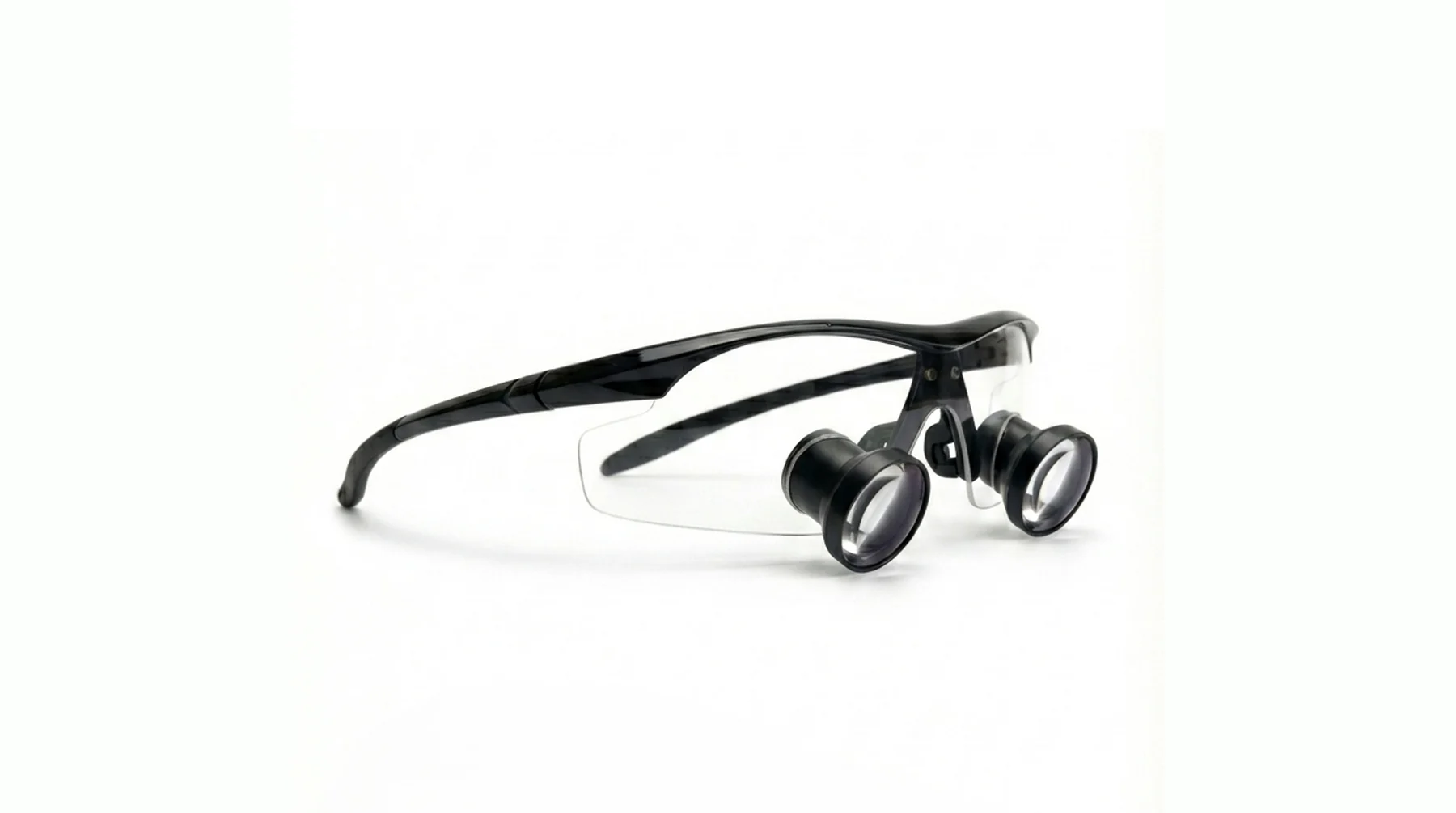
Galileo
From $795Lightweight affordable surgical and dental loupes for students, residents, and everyday clinical use.
A lightweight Galilean option; not an ergonomic prismatic system.
Explore GalileoSurgical magnifying glasses
Short answer: Surgical magnifying glasses are what surgeons call loupes: two small telescopes mounted in a spectacle frame and focused at your working distance, usually 2.5x to 6x. Unlike reading glasses or headband magnifiers, they keep a sharp image at arm's length while you stand or sit upright. HeliosX makes five custom-fit models from $695 to $2,075, with a lifetime warranty and 30-day returns on non-prescription pairs.
If you searched for magnifying glasses for surgery, you are looking for surgical loupes. This page explains the types, how much magnification you need, and what each costs, so you can compare like with like.
We make and sell HeliosX loupes. This is our buying guidance, not an independent product test or paid ranking.
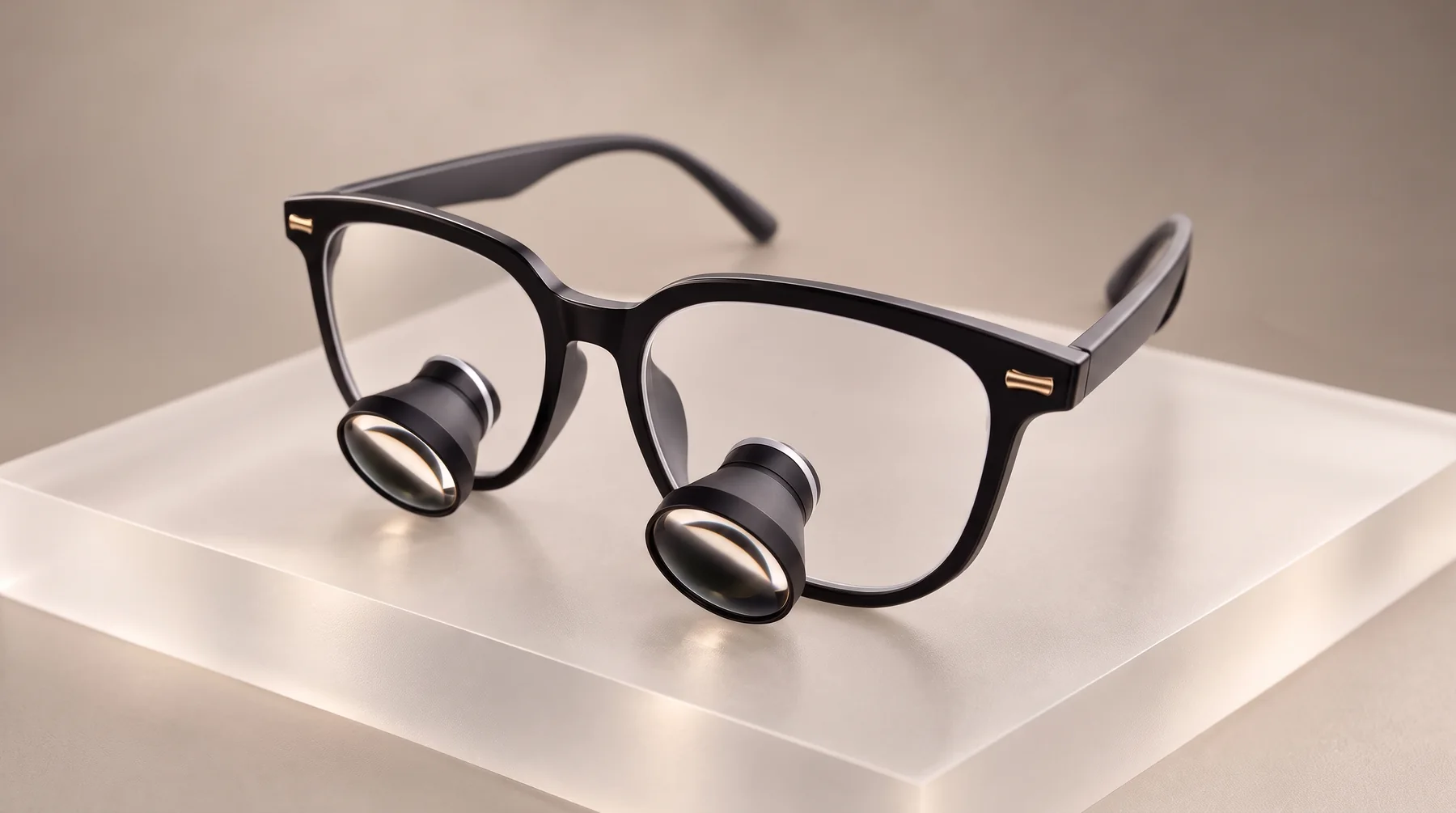
Galileo · From $795 USD
Published prices in USD. Every pair is built to your pupillary and working distance, with frame, worldwide shipping and a lifetime warranty included.
| Model | Optics | Magnification | Weight | Working distance | Best for | Price |
|---|---|---|---|---|---|---|
| Newton | Galilean | 2.5x–3.5x | 40–50 g with frame | Fixed, measured to you | Lowest-priced first pair | $695–$725 |
| Galileo | Galilean | 2.5x–3.5x | 35–37 g | Fixed, measured to you | Everyday dental and surgical work; six frame styles included | $795–$825 |
| Kepler | Conventional prismatic | 4.0x–6.0x | 68–85 g with frame | Fixed, measured to you | Fine detail at higher magnification | $1,195–$1,255 |
| Apollo | Ergonomic prismatic | 3.0x–6.0x | 55–58.2 g with frame | Fixed: 420, 450, 500 or 550 mm | A more upright head in one working position | $1,695–$2,070 |
| Medusa | Ergonomic prismatic | 3.0x–8.5x | 56–65 g with frame | Adjustable, 300–600 mm | Switching between sitting and standing | $1,695–$2,075 |
Prescription lenses add $200. Verified students, residents and fellows get 15% off. Weights are as published on each product page; Galileo's figure does not state whether the frame is included.
Your HeliosX shortlist
Compare the optical design, then choose your magnification and frame on the product page.
Lightweight affordable surgical and dental loupes for students, residents, and everyday clinical use.
A lightweight Galilean option; not an ergonomic prismatic system.
Explore GalileoConventional prismatic loupes for higher-magnification work, available in 4.0x, 5.0x, and 6.0x.
Conventional prismatic optics. Choose Apollo or Medusa for ergonomic viewing.
Explore KeplerErgonomic prismatic loupes for clinicians who want posture-aware clarity and high-magnification options.
Working distance is fixed to your configuration; magnification is selected at purchase.
Explore ApolloOur lowest-priced Galilean model, with 2.5x, 3.0x, and 3.5x configurations for everyday magnification.
Galilean optics. Choose Apollo or Medusa for a redirected ergonomic view.
Explore NewtonStarting prices in USD. Magnification and optional prescription lenses affect the total; shipping and taxes appear at checkout. See all five models.
Reading glasses and simple magnifiers enlarge an image only when you hold it close. Surgical loupes are telescopes aimed at a fixed point, your working distance, so the field stays sharp 30–60 cm away while you keep a working posture. Headband and visor magnifiers are built for hobby and bench work and do not focus to your measured distance.
Galilean loupes are lighter and give a wide, deep view at 2.5x–3.5x, which suits training and general work. Prismatic loupes fold the optical path with prisms to reach 4x and above. Ergonomic prismatic loupes also bend your line of sight so your head can stay more upright.
Most residents and general surgeons start at 2.5x–3.5x. Plastic, hand, vascular and fine reconstructive work often uses 4x–6x. Higher magnification shows more detail but a smaller, shallower field, so choose the lowest power that shows your finest routine task.
Surgical magnifying glasses only focus at the distance they are built for. HeliosX builds each pair to your pupillary distance and the working distance you measure in your operating posture, and reviews the measurements before production.
Yes. "Surgical magnifying glasses", "surgical telescopes" and "binocular loupes" all describe the same thing: magnifying telescopes mounted in a frame and focused at your working distance.
HeliosX pairs cost $695–$725 (Newton), $795–$825 (Galileo), $1,195–$1,255 (Kepler), $1,695–$2,070 (Apollo) and $1,695–$2,075 (Medusa). Representative-sold brands usually run $2,000–5,500.
They are not designed for it. Neither focuses at a measured working distance, so you end up leaning in to get a sharp image.
Yes. HeliosX adds prescription lenses for $200 per pair.
Premium magnification. More accessible.
Tell us your specialty, typical procedures, current magnification, and budget. We can help you narrow the options before you order.
Email opens in your mail app: heliosxloupes@gmail.com · Limited lifetime warranty